

Practical example of bicycle gears calculators to see the impact of moving to a bigger or smaller chainring or cassette
Whether it is 10 or 11 or 12 speed doesn’t make that big a difference. What we are looking for here are the highest and lowest gears in each case. So you can compare the top end speed vs the climbing ability for each setup. The math is easy and you can do that yourself. Or you can use the bicycle gears calculator as on bikecalc.com/archives/gear-ratios.html
12-speed background
I am Currently on a SRAM XD driver that allows for the smaller than 11t cog at the back. And considered a Shimano Microspline that can also go smaller. And if you have an HG driver you are limited to a smallest cog of 11t. Typically ‘smaller’ means a 10t smallest cog on the cassette. But the current one I have has the smallest 9t cog and it certainly does make a difference. However it didn’t quite last as long as I had hoped. Let’s find out what I stand to gain or lose be swopping out the chainring or moving from SRAM XD to Shimano’s Microspline or not. Bicycle gears for everyone.
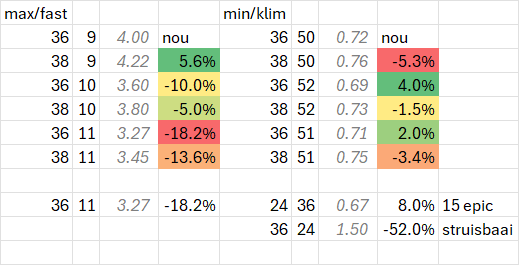
Currently using 36T chainring with a 9-50 cassette
And I love it. Truth be told, at first, I through the combo would be too hard to climb on the ABSA Cape EPIC. Especially when there are so many bikes around with a 34T chainring and cassette that goes to 52t at the back – allowing for 10% easier climbing. But it was perfectly fine and I am very happy to stay as is. Current bicycle gears.
- 36/9=4.00
- 36/50=0.72
Considered a bigger chainring 38T with the same 9-50 cassette
Climbing isn’t the problem. So, a bigger chainring can work. Up from 36T to 38T will increase the top end by 5% and decrease the climbing ability by 5%. Roughly. In other words, not as far out as I expected. But the 9t smallest cog at the back already allows for brisk progress. Likely bicycle gears.
- 38/9=4.22
- 38/50=0.76
Swopping to Shimano 36T with their 10-51t cassette
As a sidenote. It seems easier to get larger chainrings for SRAM than for Shimano. Be that as it may, swopping to Microspline and their 10-51t cassette would mean I lose 10% in top end speed. But then climb 4% easier than now. Not the best trade off. What about a bigger chainring then? Shimano bicycle gears.
- 36/10=3.60
- 36/51=0.69
Shimano 38T with the 10-51t cassette
It seems a no-brainer that if I consider swopping to Microspline then it should be paried with a bigger chainring. Ie 38T at the front. Even though it is a CSIXX or similar non-Shimano item. Which I currently have and it works perfectly fine. 38T with the 10-51t cassette will mean I lose about 5% in top-end compared to now, yet climb at near-as-makes-no-difference the same rate.
- 38/10=3.80
- 38/51=0.73 (vs 0.72)
Look how far we have come
Me previous bike was a 2015 EPIC comp with a 2x drivetrain with 36/24 upfront. Which I later changed to a 38/24. And a 11-36t cassette at the back. This means a top end of almost 15% slower than now. While climbing was a good 8% easier…
- 38/11=3.45
- 24/36=0.67 (!)
And what happened last week(end)
Fortunately Struisbaai is fairly flat. We were there on a boys weekend last weekend. And obviously went cycling every day. Until my chain came off in the sand, got stuck behind the spokes and I bent the chainring. I thought it would have been the hanger but no. this came to light when a new drivetrain was fitted at Specialized last week. Either way, the chainring caused my chain to slip off whenever I shifted into easier gears, essentially leaving only the bottom half of the cassette to safely navigate without losing your crown jewels on the top tube when the chain slips off again. Which meant I went up the steep climb on a max gear of 36/24=1.50! Which certainly felt like twice as hard to climb. And not sustainable. Not good for the knees. But good for the ego.
Where can we send you bicycle next – all bicycle gears & ratios are welcome!


