

Cycling watts: WATT do you say?
I went for a spin with local wine lawyer (and the only person who had his Wines2Whales team name exactly the same as his vehicle registration number plate, ie WINELAW) Danie Cronje the other day. Danie is a purist road cyclist and keen triathlete and he picked the route. Over coffee he commented about average watts into the wind and uphill. Versus watts per kilogram of bodyweight. And outright or absolute watts, irrespective of rider weight. The same conversation came up again around the dinner table at W2W last weekend. So I started to play around with some numbers.
WATT are you sinking about?
My routine
I work and I have kids and a full schedule and even though I try to make time for being healthy the result isn’t always that easy to achieve. So for the most part I try and do a bit of exercise on most days of the week. But my go-to is always a spin class at Maties. Typically 45 mins in the afternoon right after COB because that is what time allows. No more strength training or anything else for that matter, and when we aren’t taking part in the odd race with Chris then cycling outside for my consists of a 25km stint out and back from home to Jonkershoek gate on the most beautiful tar road just to have a coffee and talk cycling with Bram, Dewald, Natasha, etc. Very few cycling watts being used for same.
My results
I don’t have a power meter on any of my bicycles. And I don’t use a HRM heart rate monitor strap. Because I know when the ticker is working hard. And when it isn’t. I certainly don’t need the GPS to shout at me while enjoying some time on the bike. Here below are some random results from efforts this year. In no specific order. On the indoor trainer. In the gym. Proper bikes. And I have done it on a vast range of different bikes as well, but that is the topic for another post. And the results below came from snaps that I took of the wattbike screen after each effort. Obviously I only took a photo if it felt like a worthwhile effort. These are well earned cycling watts.
5min FTP test
- FTP result 481 watts
- FTP result 466 watts
- FTP result 436 watts
- FTP result 417 watts
Average cycling watts over a session
- 440 watts for 36 mins
- 426 watts for 40 mins
- 400 watts for 47 mins
1000 cycling watts on demand
I can build some momentum and flick the switch of the trainer to max and then pedal swiftly to get to over 1000 watts for short bursts. And then sleep like a baby at night. So there are some reserves when required. However, it doesn’t come without a pounding heartrate afterwards! 1000 cycling watts keep you/me busy.
Cycling watts per kilogram
This is where it gets interesting. The raw numbers look high. But I weigh 110 kgs. So the 5 minute FTP test results of 417, 436, 466 and 481 watts above thus translate to 3.8, 4.0, 4.2 and 4.4 watts per kg. And the 3 examples of longer sessions of 400, 426 and 440 watts for sustained efforts of over half an hour to three quarters of an hour thus equals 3.6, 3.9 and 4.0 watts per kg. All things considered, around 4 watts per kg.
FTP test results
- 4.4 watts per kg
- 4.2 watts per kg
- 4.0 watts per kg
- 3.8 watts per kg
Sustained efforts
- 4.0 watts per kg
- 3.9 watts per kg
- 3.6 watts per kg
By comparison, a rider of 65kgs in bodyweight only needs 260 watts to have the same 4 watts per kg output as the 440 watts per kg for someone of 110kgs in bodyweight. And Matt Beers at 1.95m tall and 81kgs shared in this TR interview his first FTP test came in at 420 watts.
How does it compare?
The first FTP bell curve for cycling I found online is the one below from a dataset from Trainerroad where the average FTP is 232 for all users and 237 for all users with a power meter. So just under 240 cycling watts per rider. And 400 is the max FTP recorded with a power meter in this specific distribution. Which places me above average for the outright numbers. Here is the cycling watts FTP distribution:
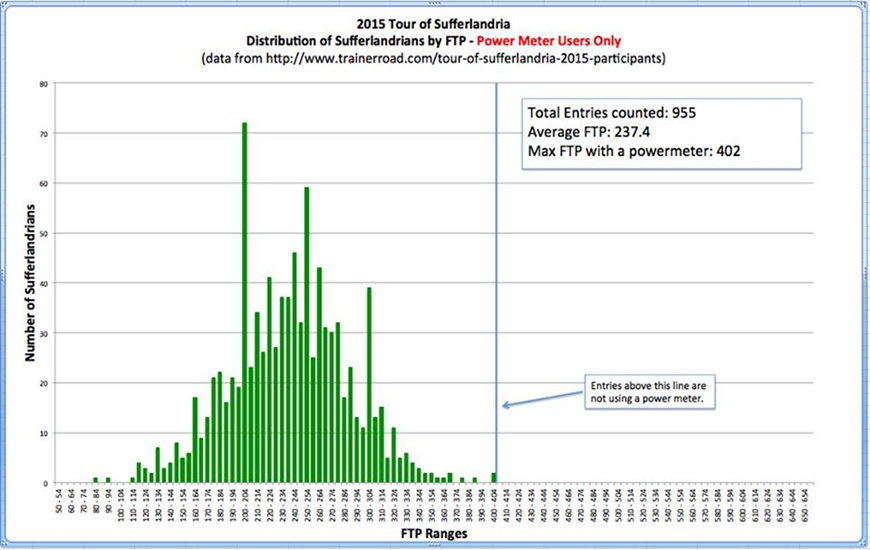
But what I am really interested in is the watts per kg because that changes the situation slightly. And further down in that same article the answers shows as follows: From todays podcast (185), “[…] almost perfect bell curve with the average at 3W/kg and about 7% of people above 4W/kg”. Which also places me surprisingly much higher than expected. And here is how it stacks up to the cycling watts per kg bell curve:

WATTS next?
Maybe it is time to shed a few kgs and see what the results are then. And the biggest compliment I have received this week at W2W while going uphill was from a fellow rider and I quote verbatim: “HOLY FUCK, you’re as big as a house and still pulling away from all of us on the hill”. That makes me laugh. And a little proud. I try.
—
Forget about the FTP numbers and watts – where can we send your bicycle today?


